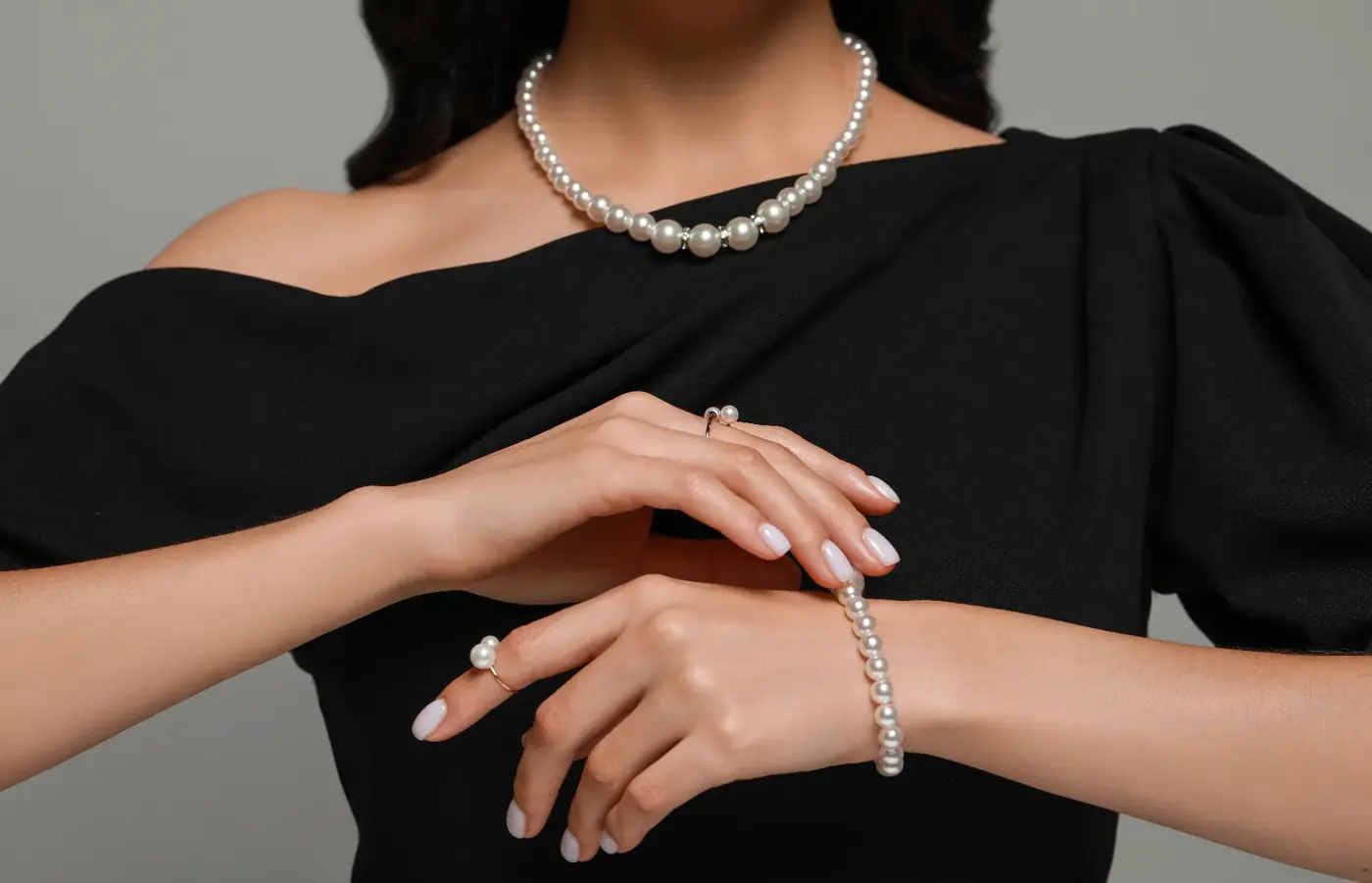
The pearl necklace, chosen strand by strand
A pearl necklace is judged in the hand: lustre, surface, matching and the quality of the knotting. Lucio's Gold in Markham lets you compare strands side by side.
How to judge a pearl necklace before you buy
Judge a pearl necklace by lustre first, then surface, shape, size and colour, and finally how evenly the pearls match along the strand. GIA lists seven value factors, and lustre is often the most telling. Hold the strand under daylight and look at how sharp your reflection appears in each pearl.
A good strand looks alive, the way a pearl glows against skin. Light enters the thin layers of nacre and returns with depth, and a flat photo cannot show it.
Turn the strand slowly under a window. Look for dents, spots and ridges, and notice whether the pearls look glassy or chalky. A chalky pearl often points to thin nacre.
Then check the matching. On a fine strand the pearls sit in a smooth line, with colour and size graded evenly from the clasp to the centre. We like to spend time on this with you, because the differences show quickly once someone points them out.
- Lustre: how bright and sharp the reflections are
- Surface: how clean the skin of each pearl is
- Shape: round, near-round, oval, baroque
- Matching: how evenly size and colour run along the strand
The best test of a pearl necklace is one you can hold up to the light.

Freshwater pearl necklace: what to expect
A freshwater pearl necklace is strung with pearls grown in mussels, mostly in China. These pearls come in many shapes and natural colours, from round to rice-shaped, and they suit everyday wear well. Quality still varies a great deal, so lustre, surface and matching matter just as much here.
Freshwater pearls give you range. You can find near-round beads, soft ovals, flat coin shapes and irregular baroque forms, often in white, cream, blush and lavender tones.
Because mussels can produce many pearls at once, freshwater strands are common, and the choice is wide. That is useful, since you can compare several strands in a single visit.
Look closely at the surface and the shine. Round, bright, evenly matched freshwater pearls are harder to find than irregular ones, and the strand will show it. Ask us anything about what you are seeing.

| Type | Where it grows | Typical character |
|---|---|---|
| Akoya | Saltwater oysters, mainly Japan and China | Round, sharp lustre, about 6 to 9 mm |
| Freshwater | Mussels, mainly China | Many shapes and natural colours |
| Tahitian | French Polynesia | Darker shades, larger sizes |
| South Sea | Saltwater, Australia the largest producer | Among the largest pearls |
What a cultured pearl necklace really is
A cultured pearl necklace uses pearls grown with human help: a technician places a nucleus or tissue piece in the oyster or mussel, and the animal builds nacre around it. Natural pearls form without that step and are far rarer. Nearly every pearl strand you see in a shop today is cultured.
Cultured does not mean fake. A cultured pearl is a real pearl, made by a living animal, with a person starting the process.
An imitation pearl is something else: a glass or plastic bead with a coating. It can look good from a distance, yet it feels and behaves differently in the hand.
Our guide on how to tell real pearls from fake walks through the simple checks, from the feel against your teeth to the look of the drill hole. Bring a strand in and we will go through it with you.
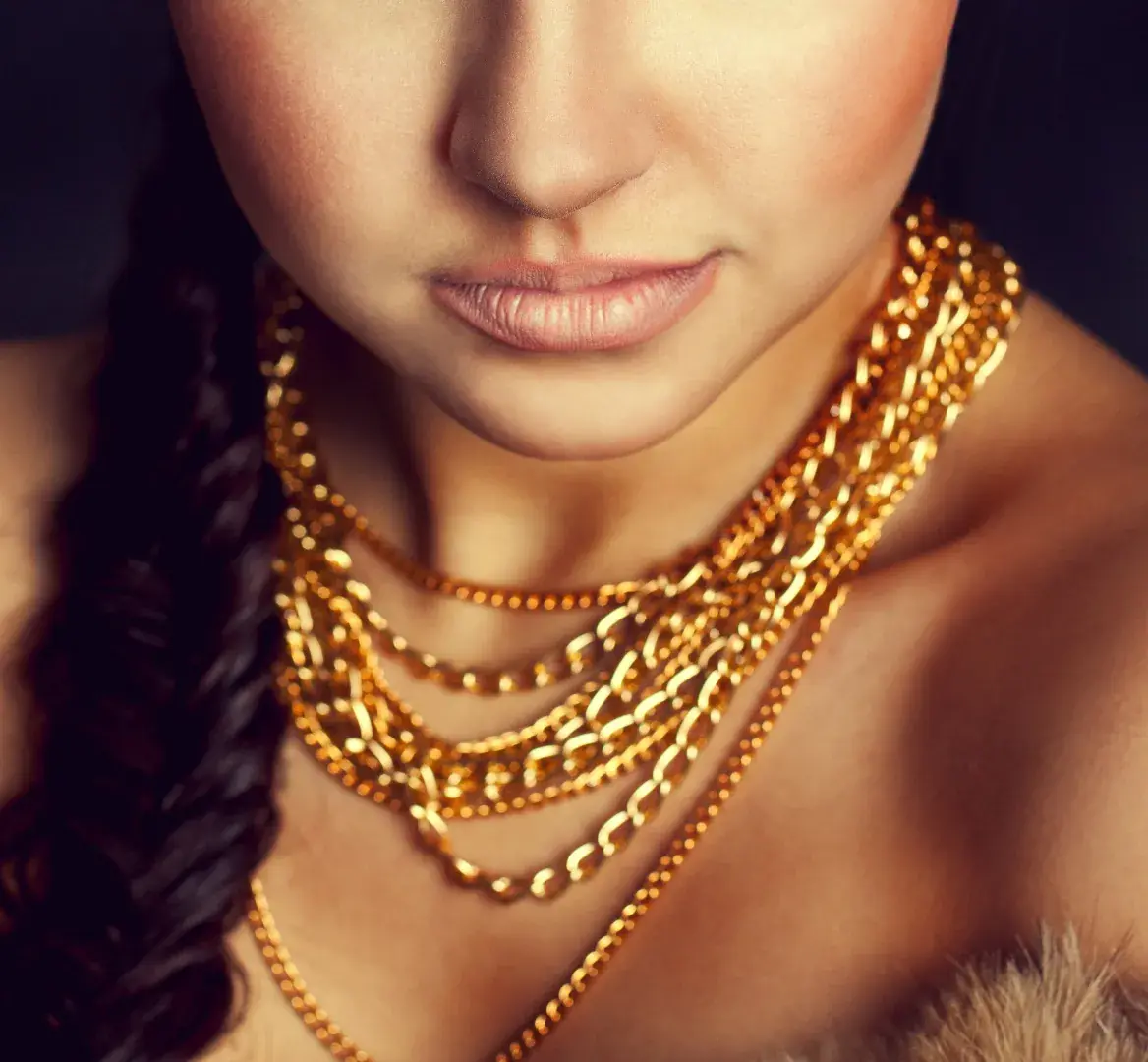
Try three lengths in front of a mirror before you decide.
Pearl necklace lengths, from choker to rope
Pearl necklaces are sold in standard length names, and each sits differently on the body. A choker hugs the base of the neck, a princess length rests near the collarbone, a matinee falls lower, and an opera or rope strand can be doubled. Exact inches vary a little between sellers, so try them on.
Trade guides commonly place a choker at about 14 to 16 inches and a princess length at about 17 to 19 inches. A matinee usually runs about 20 to 24 inches.
Opera strands start somewhere near 28 inches, and a rope runs longer still. Sellers differ by an inch or two, so treat these as a rough map and not a rule.
The right length depends on your neckline and how you wear it. A princess strand sits well under a collar. A longer strand can be knotted or doubled for a different look. Try three lengths in front of a mirror before you decide.

Choosing a pearl necklace for women: size, colour, clasp
A pearl necklace for women is chosen by pearl size, colour tone, length and clasp. Smaller pearls look delicate and sit close to the neck. Larger pearls make a bolder line. Cream, white, rose and darker tones flatter different skin colours, so hold each strand near your face before you decide.
Pearl size is measured in millimetres across the bead. Smaller pearls read as quiet and fine. Larger ones draw the eye and feel heavier on the neck.
Colour matters more than people expect. Look at the overtone, the faint tint that floats over the body colour, and see how it behaves against your skin and your usual clothing.
The clasp is worth a look too. A secure clasp, in silver or gold, is the part you will handle every time you put the strand on. Ask to see how it closes and how easily it opens.

A pearl necklace in Toronto and the GTA: come and see it
If you want a pearl necklace in Toronto or anywhere in the Greater Toronto Area, Lucio's Gold is a family-owned shop at 7800 Woodbine Ave in Markham, near Highway 404 and Highway 407. We have served the GTA for more than 30 years. Visit to compare strands in daylight and ask questions.
Pearls reward a visit. Come and try a strand on, and see how it sits at your collarbone. Colour, lustre and weight read differently on your skin than on a screen, and you can only judge that in person.
We encourage you to shop around and compare. A good jeweller is glad to see you do it, and we would rather you choose a strand you love than one you doubt. There is no pressure here, and we explain the choices.
Our silver and pearl jewellery range sits together, so you can look at the clasp metal and the pearls at once. Call (905) 475-1702 before you drive in and tell us what you are looking for.
Caring for a pearl necklace
Pearls are organic and soft, so they need gentle care. Put your pearl necklace on last, after perfume, hairspray and lotion, and take it off first. Wipe it with a soft, slightly damp cloth, then lay it flat to dry. Never soak it, and keep it away from harsh cleaners.
Pearl is far softer than a diamond or a sapphire. Rough surfaces, hard knocks and chemicals can all dull the skin of a pearl.
Store the strand on its own, in a soft pouch, away from sharp pieces that could scratch it. Hanging a heavy strand for long stretches can stretch the thread.
For general advice on keeping jewellery fresh, read our guide to cleaning jewellery at home. Pearls need the gentlest version of that advice, so skip ultrasonic and steam cleaners.
Pearl restringing and repair
We repair necklaces, and that includes restringing a pearl strand. Pearls are usually strung on thread with a knot between each bead, so that one failure does not scatter the rest and the pearls do not rub together. If your strand looks stretched, dirty or frayed, bring it in and we will look at it.
Thread weakens with wear. Skin oils, sweat and plain friction all take their toll, and a strand that has been worn often will eventually need new thread.
Signs it is time: a visible gap between pearls, a thread that looks grey or frayed, or a clasp that feels loose. Do not wait for it to break at an event. A fresh thread lets the strand be worn, and passed down, with confidence.
Our jewellery repair work covers necklaces and clasps. If you also want a strand's value written down for insurance, we write jewellery appraisals.
Clasps, settings and pairing with other pieces
A pearl strand is often finished with a clasp in sterling silver or gold, and the metal you pick changes the look. Silver gives a cool, bright finish. Yellow gold gives warmth. You can also pair the strand with matching earrings, or a separate silver chain, to build a set with a clear logic.
Think about what you already wear. If your jewellery is mostly white metal, a silver clasp will sit quietly. If you wear a lot of yellow gold, the warmer clasp may suit you better.
A matched pair of pearl earrings completes a strand without crowding it. A plain silver chain can also be worn at a different length beside the strand.
If you want something that does not exist yet, ask about custom jewellery. A pendant, a drop or a clasp can be designed around the pearls you choose.
Questions, answered
What is the best pearl necklace to buy?
The best pearl necklace is the one with strong lustre, a clean surface and evenly matched pearls that you enjoy wearing. Type matters less than quality: a bright freshwater strand can beat a dull saltwater one. Compare several in daylight and ask us to explain differences you can see.
How much is a freshwater pearl necklace?
Cost depends on pearl size, shape, lustre, surface and the length of the strand, so we do not give a single figure here. Visit 7800 Woodbine Ave or call (905) 475-1702 and tell us what you like. We will help you compare strands on quality, not only on cost.
Is a cultured pearl necklace real?
Yes. A cultured pearl is a real pearl grown in an oyster or mussel with human help, where a nucleus or tissue piece starts the nacre. It differs from an imitation, which is a coated glass or plastic bead. Nearly all pearl strands sold today are cultured.
What length of pearl necklace should I get?
Princess length, about 17 to 19 inches, is a common starting point because it sits near the collarbone and suits most necklines. Choker lengths sit higher and matinee lengths lower. Sellers vary by an inch or two, so try several lengths in a mirror.
Where can I buy a pearl necklace in Toronto?
Lucio's Gold, a family-owned jewellery shop at 7800 Woodbine Ave in Markham, shows pearl strands to customers from across Toronto and the GTA. We have served the area for more than 30 years. Call (905) 475-1702 to say what you want to see.
Can you restring my pearl necklace?
Yes. We repair necklaces, including restringing pearl strands with a knot between pearls. Bring it in and we will check the thread, the pearls and the clasp together. If a pearl has cracked or loosened, we will tell you what we see.
How do I care for a pearl necklace?
Put it on after perfume and hairspray, take it off first, and wipe it with a soft damp cloth. Lay it flat to dry and store it apart from other pieces. Avoid soaking, ultrasonic cleaners, steam and chemical cleaners, because pearls are soft and organic.
Book a private consultation
Planning the pearl necklace, chosen strand by strand? A short note is enough to begin. Use the form, call (905) 475-1702, or visit us on Woodbine Avenue in Markham.
7800 Woodbine Ave, Markham, ON L3R 2N7
(905) 475-1702